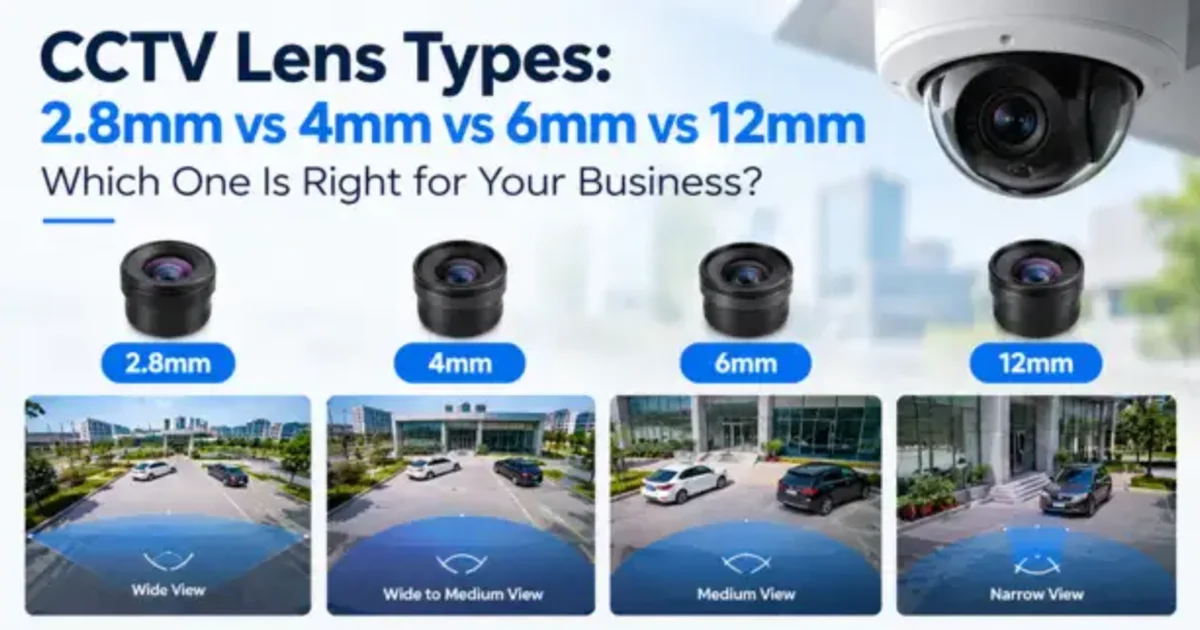
CCTV Lens Types: 2.8mm vs 4mm vs 6mm vs 12mm — Which One Is Right for Your Business?

CCTV lens types of comparison

Introduction

Picking the right CCTV lens matters. It helps your cameras show footage that is sharp and actually useful for your business.

You have to match the lens to a few things. Start with the size of the area you want to cover. Then think about how far the camera will be from the scene. After that, decide how much detail you need to see.

Why Choosing the Lens Is Important

  • ♦ It sets the view for the space you are watching.
  • ♦ It makes details easier to see, like faces and cars.
  • ♦ It cuts down on blind spots and limits wasted coverage.
  • ♦ It supports solid CCTV results in both small rooms and big areas.
  • ♦ It helps a business not pick the wrong lens.

  • Understanding CCTV Lens Types

    Fixed Lens

  • ♦ This lens has one set focal length, like 2.8 mm, 4 mm, 6 mm, or 12 mm.
  • ♦ The view angle stays the same.
  • ♦ It works best where the camera spot is known and does not change.
  • Varifocal Lens

  • ♦ The focus range can be changed.
  • ♦ This helps when the viewing distance is unclear at install time.
  • ♦ It lets an installer dial in the camera angle once the setup is already in place.
  • Focal Length

  • ♦ It is shown in millimeters (mm).
  • ♦ With a shorter focal length, you get a wider scene.
  • ♦ With a longer focal length, you see a tighter view and more detail far away.

  • Difference Between 2.8mm vs 4mm vs 6mm vs 12mm

    CCTV Lens Viewing Area Best For Main Advantage
    2.8mm Very wide Small rooms, reception areas, corridors Covers a wider area
    4mm Wide to medium Offices, entrances, small outdoor areas Good balance of coverage and detail
    6mm Medium Parking areas, gates, corridors Better detail at a longer distance
    12mm Narrow Long corridors, gates, large outdoor areas Better for distant objects

    A quick rule of thumb is this: 2.8 mm tends to show a wider area. A 12 mm lens usually shows a tighter view. That tighter view is often a better fit for looking farther out. The exact coverage depends on the camera sensor and how high the camera is mounted.

    How You Frame the Scene

  • ♦ 2.8 mm: Good if you must see a wide area and you are close.
  • ♦ 4 mm: Works well for day-to-day office monitoring.
  • ♦ 6 mm: Better when the person or object is farther away.
  • ♦ 12 mm: Helps you pick out details in far spots.
  • Before you choose a lens, think about the camera's height, the distance to the target, the sensor size, and how sharp you need the identification to be.


    Lens Picking Errors People Make

  • ♦ Buying a lens just because it is cheap.
  • ♦ Pick a narrow lens when you actually need a wider view.
  • ♦ Choose a wide lens when you need clear details from far away.
  • ♦ Forgetting to think about how far the camera is from the subject.
  • ♦ Mounting cameras without confirming the viewing angle that is needed.

  • Picking the Correct Lens for the Job

  • ♦ Walk around space first and spot the key areas.
  • ♦ Find out how far the camera will sit from the subject.
  • ♦ Decide if you need a wide view or a closer look.
  • ♦ Choose the focal length and the camera sensor that fits.
  • ♦ Try the setup and make small changes before you mount it.

  • Conclusion

    Picking a 2.8mm CCTV lens instead of a 4mm one, or choosing a 6mm lens over a 12mm lens, comes down to what you need to cover and how far you must see. The best lens setting helps you cover the area you care about and gives sharper views for seeing details. That in turn supports stronger protection for your business.

    Trying to pick the right CCTV lens for your project?

    Abiding Technical Services LLC can review what your site needs. We can then suggest CCTV cameras, the right lenses, and the best coverage for offices, job sites, facilities, and commercial properties.

    Reach out to Abiding Technical Services LLC for a CCTV consultation and a site visit.