Introduction
CCTV cameras can show what is happening in an area, but seeing an area does not always mean that a person can be identified clearly. Understanding CCTV identification, camera resolution, lens selection, and coverage helps businesses choose the right surveillance system.
What is Seeing an Area on CCTV?
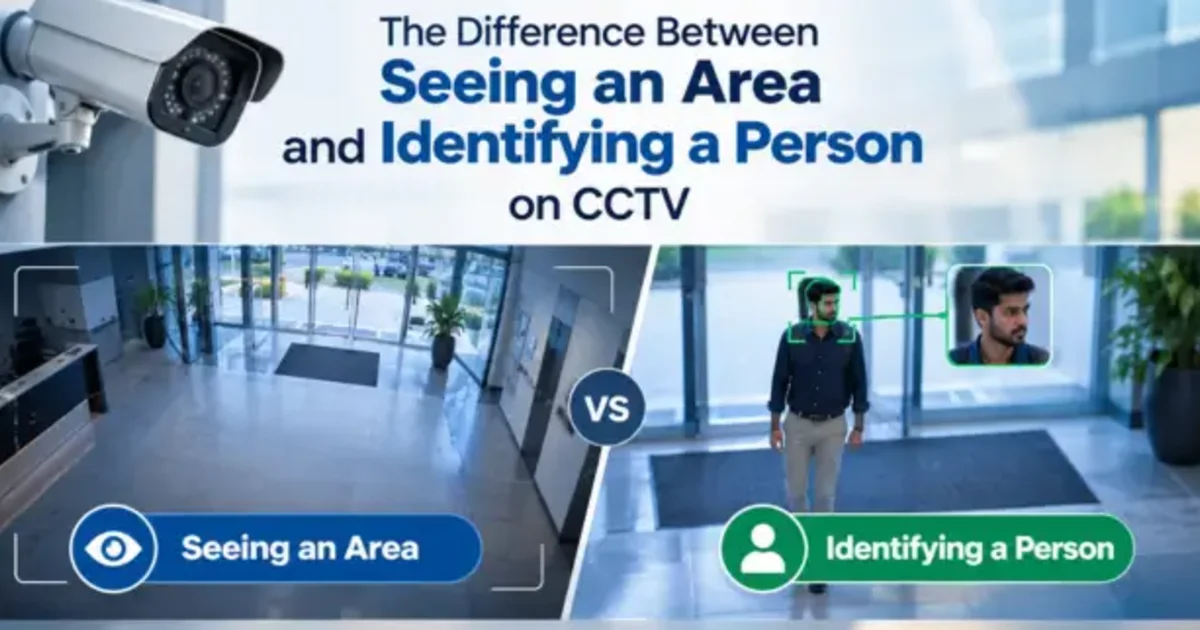
Seeing an area means the CCTV camera provides a general view of a location such as an entrance, parking area, office, warehouse, or construction site. People and activities can be seen, but facial details may not be clear enough for identification.
What is Identifying a Person on CCTV?
Identifying a person means the CCTV footage provides enough detail to recognize important features such as the face, clothing, or other identifying characteristics. Proper CCTV camera resolution, positioning, lighting, and lens selection are important for reliable identification.
Seeing vs Identifying
| Seeing an Area | Identifying a Person |
|---|---|
| Provides a wide view of the location | Provides detailed views of individuals |
| Shows general movement and activity | Shows facial and identifying details |
| Covers a larger area | Focuses on important areas or entry points |
| Useful for general monitoring | Useful for investigation and identification |
| Requires wider CCTV coverage | Requires suitable camera placement and resolution |
What Does CCTV Coverage Actually Mean?
CCTV coverage refers to the area that a camera can effectively monitor. Good coverage should provide enough visibility while maintaining useful details where identification is required.
Why a High-Megapixel Camera Alone Is Not Enough
A high-resolution CCTV camera can capture more image detail, but megapixels alone do not guarantee successful identification. The complete camera setup must be planned according to the site and security requirement.
Common CCTV Identification Mistakes with Solutions
| Common Mistake | Solution |
|---|---|
| Using one camera for a very large area | Use multiple cameras or combine wide and focused camera views. |
| Choosing a lens without considering distance | Select the lens based on the required viewing distance and area. |
| Installing cameras too high | Position cameras to capture useful facial and identifying details. |
| Ignoring lighting conditions | Use suitable low-light, IR, or additional lighting solutions. |
| Focusing only on megapixels | Consider resolution, lens, distance, lighting, and positioning together. |
| Not covering entry and exit points properly | Prioritize gates, doors, reception areas, and other access points. |
| Assuming wide coverage means identification | Use dedicated camera views where detailed identification is required. |
| Ignoring recording and storage quality | Use suitable recording settings, storage capacity, and video quality. |
Conclusion
Effective CCTV is not only about seeing an area; it is also about capturing enough detail when identification is required. Proper CCTV coverage, camera resolution, lens selection, positioning, and lighting help businesses build a more useful surveillance system.