Introduction
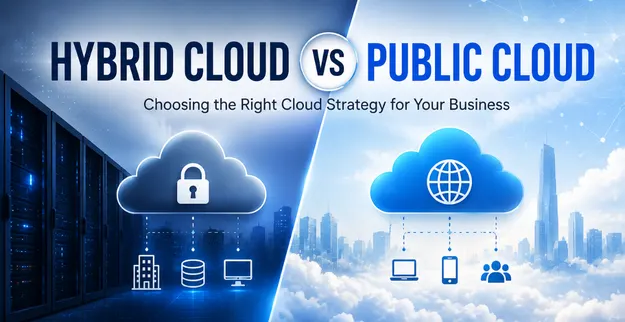
Picking the right cloud model might help your business feel more flexible, more secure, and with better IT performance, yeah. Hybrid Cloud and Public Cloud both bring useful things, but the advantages change a bit depending on what you actually need day to day, plus your budget, and what kind of infrastructure you already run.
Cloud Models
Hybrid Cloud
♦
It kind of mixes private infrastructure with those public cloud services, like, not all in one place.
♦
Normally it leaves sensitive data or mission critical systems inside a private environment, so they are more controlled.
♦
And still it lets you pull in public cloud resources when it’s needed, for example when workloads spike or something.
Public Cloud
♦
This is when cloud services are used through shared, multi-tenant infrastructure, so everything kind of runs on that same backbone.
♦
With this setup, resources can be scaled fast based on business needs, or rather the workload you get at the moment.
♦
It works best for organizations that want flexible Cloud Infrastructure, but also something simpler to manage without too much fuss.
Feature Comparison
| Feature |
Hybrid Cloud |
Public Cloud |
| Infrastructure |
Private + Public |
Public |
| Security |
Higher control |
Provider-managed |
| Scalability |
High |
Very High |
| Flexibility |
Very High |
High |
| Management |
More complex |
Easier |
| Best For |
Sensitive and critical workloads |
General business workloads |
Cost
1. Hybrid Cloud
♦ It tends to demand investment in private infrastructure, so there’s that upfront thing.
♦
It can cut down on public cloud expenses for workloads that are sensitive, or that get used again and again, more or less.
♦
But honestly the upkeep and management costs can end up being a bit higher than expected, with more moving pieces around.
2. Public Cloud
♦
Usually, the setup comes with lower upfront infrastructure costs.
♦
Pay-as-you-go pricing makes it easier to manage first expenses.
♦
Still, the costs can creep up as storage; more users, and additional cloud resources grow.
Best Choice
Hybrid Cloud
♦
Often the best fit for companies dealing with sensitive, or critical data, you know the kind that really can’t afford delays.
♦
It tends to work well when you need more control over the infrastructure, not just a plug-and-play setup, because some parts still must stay close.
♦
It's also a solid option for teams that want both securities along with cloud scalability, like keeping the right balance between safety and growth.
Public Cloud
♦
This is best for businesses who need a fast launch; deploy pretty quick without much friction.
♦
It fits startups, growing companies, and every day, standard workloads; you know the kind that doesn’t need ultra special tuning.
♦
You’d typically pick it when lowering infrastructure management is the focus, like freeing up time and effort for the real work.
Problems and Solutions
| Cloud Model |
Problem |
Solution |
| Hybrid Cloud |
Complex management |
Use centralized monitoring and professional cloud management. |
| Hybrid Cloud |
Integration issues |
Plan connectivity and system compatibility before deployment. |
| Hybrid Cloud |
Higher maintenance costs |
Regularly review infrastructure and optimize cloud usage. |
| Public Cloud |
Security concerns |
Use strong access controls, encryption, and security policies. |
| Public Cloud |
Unexpected cloud costs |
Monitor usage and set budgets or spending alerts. |
| Public Cloud |
Provider dependency |
Maintain regular backups and a clear business continuity plan. |
Conclusion
Both Hybrid Cloud and Public Cloud can help modern businesses, if they are actually implemented correctly, not just on paper. In the end, the right choice really depends on your security posture, how well you need to scale, what budget you have, and the specific cloud infrastructure requirements you’re dealing with.