Hyper-V vs Docker: What UAE IT Teams Should Actually Use?
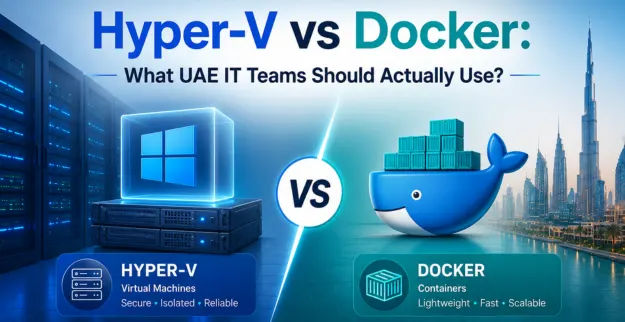
Businesses across the UAE are moving quickly toward cloud computing, virtualization, and DevOps style practices to push performance up and lower IT costs down. And yeah, when it comes to figuring out what the difference is between Hyper-V and Docker, it is not just academic; it helps teams pick up the better option for scalability, smoother application deployment and steadier infrastructure management.
What is a Hyper-V?
Hyper-V is basically Microsoft’s virtualization platform, kind of. Sort of it lets organizations spin up several virtual machines on only one physical server. Each virtual machine then runs its own operating system, so the workloads stay separate and guarded. It’s commonly used when you want a neat boundary between tasks without having to purchase extra hardware for everything.
In practice Hyper-V is used a lot by businesses that need things like
- ♦ Dedicated virtual servers
- ♦ A more centralized IT setup
- ♦ Disaster recovery options
- ♦ Secure business applications
- ♦ Enterprise scale virtualization
So, for construction companies, consulting firms, and facility management businesses in Dubai and across the UAE, Hyper-V can help cut equipment expenses, while also boosting server performance and keeping operations running better when something goes wrong.
What is Docker?
Docker is basically like a container platform people use, to build, launch, and run software inside these lighter weight containers. The trick is that the containers share the same operating system's kernel, so they tend to be faster, and way more efficient than old school virtual machines.
Docker is often used in, like:
- ♦ DevOps setups
- ♦ Cloud computing projects
- ♦ Application testing
- ♦ Software building, and day to day development
- ♦ Microservices style architecture
With Docker, IT teams can usually roll out applications pretty quickly across different environments, without running into compatibility headaches. It’s kind of the “ship it anywhere” approach, for many teams.
Virtualization vs Containers
| Feature | Hyper-V | Docker |
|---|---|---|
| Type | Virtual Machine Platform | Container Platform |
| OS | Separate OS for each VM | Shared Host OS |
| Performance | Uses More Resources | Lightweight & Fast |
| Startup Time | Slower | Faster |
| Best For | Enterprise Servers | DevOps & Applications |
| Scalability | Moderate | High |
| Cost | Higher Infrastructure Cost | Lower Operational Cost |
| Common Use | ERP, Databases, File Servers | Web Apps, Microservices |
Use Cases and Real-Time Examples
Hyper-V Use Cases
- ♦ A construction company running ERP software on virtualized servers, kind of like the whole thing becomes neatly isolated
- ♦ A consulting company handling multiple Windows applications, but in a secure way, like locked down and carefully segmented
- ♦ Facility management companies using centralized surveillance and monitoring systems, for both security and visibility
- ♦ Businesses building backup and disaster recovery settings, with the expectation that things will bounce back fast
- ♦ Companies moving physical servers into virtual environments, basically turning the traditional setup into something more flexible
Docker Use Cases
- ♦ DevOps teams deploy applications faster, sort of more like in a rush but consistently.
- ♦ Software companies testing applications across multiple environments; you know development staging production all that.
- ♦ Cloud computing projects relying on microservices architectures, so services get split and orchestrated.
- ♦ Businesses run lightweight web applications, where it’s easier to ship and tweak without drama.
- ♦ IT teams automate software deployment processes, so releases feel smoother and more repeatable.
Limitations of Both
- ♦ Hyper-V tends to need higher hardware resources, compared to what people expect
- ♦ Docker containers can sometimes have lower isolation than VMs, even if they are still quite strong
- ♦ Hyper-V setup and ongoing management can feel complex, especially for smaller businesses and it teams
- ♦ Docker is not ideal for applications that need full operating systems, or anything that behaves like one
- ♦ Both Hyper-V and Docker still require skilled IT management, plus continuous monitoring and fine tuning
Conclusion:
Both Hyper-V and Docker are kind of a big thing in modern IT infrastructure. Hyper-V feels better when a business wants safer virtualization, plus its own, dedicated virtual machines, and Docker works well when you need fast application deployment, along with that whole DevOps vibe. In the UAE, companies should judge what they already have, how much they expect to grow, and what the everyday operations demand, before they decide to go with one solution over the other.