NextGen Firewall vs Traditional Firewall: Key Differences
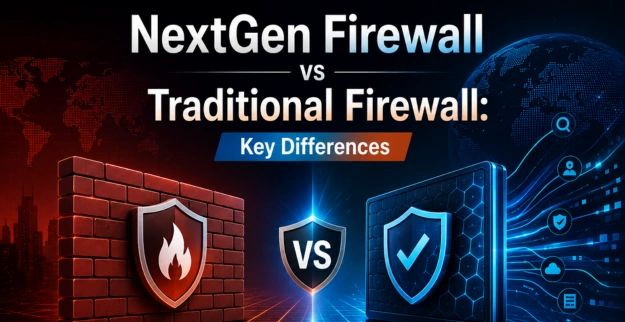
In today’s digital world, strong network security is crucial for businesses like construction, contracting, and consulting companies. The two common types of firewalls which protect networks are traditional firewalls and next generation firewalls (NGFW). The understanding of their differences enables you to select the appropriate solution which will protect your business.
What is a Traditional Firewall?
A traditional firewall creates a fundamental security boundary which separates your internal network from the internet. It filters traffic by using three criteria which include IP addresses and ports, and protocols to prevent unauthorized access.
What is NGFW?
NGFWs provide advanced network security through their fusion of standard firewall functions with their ability to perform deep system examination and their intrusion prevention system and application control features which enable them to identify and neutralize sophisticated security threats.
Feature Comparison
| Traditional Firewall | Next Generation Firewall (NGFW) |
|---|---|
| Traffic Filtering: IP addresses, ports, protocols | Traffic Filtering: Deep packet inspection, application-level |
| Threat Detection: Basic | Threat Detection: Advanced (IPS, malware detection) |
| Application Control: No | Application Control: Yes |
| User Identity Awareness: No | User Identity Awareness: Yes |
| Performance Impact: Lower | Performance Impact: May be higher due to complexity |
| Security Level: Basic | Security Level: High |
Benefits of Traditional Firewall and NGFW
- ♦ The system safeguards business networks against cyber security threats.
- ♦ The system prevents unauthorized users from entering corporate computer systems.
- ♦ The system enables organizations to protect their sensitive business information.
- ♦ The system enables users to access the internet and remote systems in a secure manner.
- ♦ The system enhances network security while providing complete monitoring capabilities.
Use Cases and Real-Time Examples
- ♦ Small offices use traditional firewalls for basic internet and network protection
- ♦ Large businesses use NGFW for advanced network security and threat prevention
- ♦ Companies with remote employees use NGFW for secure VPN access
- ♦ Businesses using cloud applications use NGFW for better monitoring and protection
- ♦ Example: A contracting company uses a firewall to secure office systems and control internet access for employees.
Limitations
Traditional Firewall: The system can only identify basic threats, and it lacks both application control and user access control features.
NGFW: The system incurs higher operational expenses and requires advanced management skills to operate.
Conclusion:
Modern businesses in the construction and consulting fields benefit from next-generation firewalls, which provide superior network security compared to traditional firewall systems. The selection of NGFW systems protects your business from developing cybersecurity threats.