RFID vs Biometric Access Control: Which is Better in 2026?
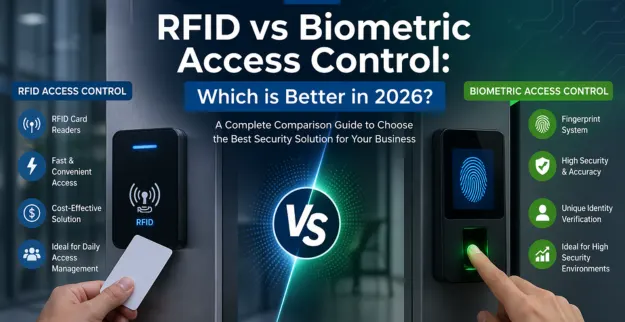
Modern businesses need to select an access control system which will provide optimal security and operational effectiveness and future growth potential. The two most common security solutions which will be used in 2026 include RFID access control and biometric access control systems. RFID card readers provide fast and convenient access, while fingerprint systems and other biometric technologies deliver superior security protection. The differences between each option help businesses pick their most suitable solution.
RFID vs Biometric
| Feature | RFID Access Control | Biometric Access Control System |
|---|---|---|
| Authentication Method | RFID card readers (cards, tags) | Fingerprint system, face recognition |
| Ease of Use | Very easy (tap and go) | Moderate (requires scanning) |
| Speed | Fast access | Slightly slower than RFID |
| Security Level | Medium (cards can be lost) | High (unique identity verification) |
| Maintenance | Low | Moderate (sensor upkeep required) |
| Scalability | Easy to expand | Scalable but more complex |
| Contact Requirement | Contactless | Mostly contact-based (fingerprint) |
1. Cost Comparison
RFID Access Control
- ♦ The cost to start this system is lower than biometric systems.
- ♦ RFID card readers and cards are available at budget-friendly prices.
- ♦ The system requires only basic maintenance, which results in low operational costs.
Biometric Access Control System
- ♦ The system incurs higher installation expenses because it uses advanced technological components.
- ♦ The system needs funding for its fingerprint identification system and facial recognition equipment.
- ♦ The system will incur additional expenses through its required maintenance and software upgrade processes.
2. Security Comparison
RFID Access Control
- ♦ People can lose their cards or people can steal their cards or people can share their cards with others.
- ♦ The system provides protection that matches essential security requirements and extends to moderate security needs.
- ♦ The system requires two different authentication methods for users to complete the login process.
The Biometric Access Control System
- ♦ The system uses distinct biological characteristics which include fingerprints and facial recognition.
- ♦ The system provides security which prevents unauthorized duplication and sharing its biometric access system.
- ♦ The system serves as the optimal security solution for environments that require maximum protection.
3. Best Use Cases
RFID Access Control
- ♦ Offices which experience frequent employee movement
- ♦ Educational institutions which include schools and universities
- ♦ Parking management systems
- ♦ Time attendance systems
Biometric as security enables access from:
- ♦ Security camera manufacturers
- ♦ Visitor and vendor monitoring
- ♦ Geographical Security Analysis
- ♦ Transportation and national defense.
4.Industry Recommendations
- ♦ Small Businesses: RFID access control for cost-effective security
- ♦ Corporate Offices: Combination of RFID card readers and biometric systems
- ♦ Healthcare & Banking: Biometric access control system for strict security
- ♦ Industrial Facilities: Hybrid systems for workforce management and security
- ♦ Smart Buildings: Integrated RFID and fingerprint systems for flexible operation
Conclusion
The year 2026 brings advantages to both RFID access control systems and biometric access control systems. RFID card readers work best for users who need an affordable and convenient access solution. The use of fingerprint systems together with other biometric solutions provides organizations with the highest level of security for identity verification purposes. Many businesses today prefer a hybrid approach to achieve the perfect balance of security and efficiency.