Server Room vs Data Center: What's the Difference?
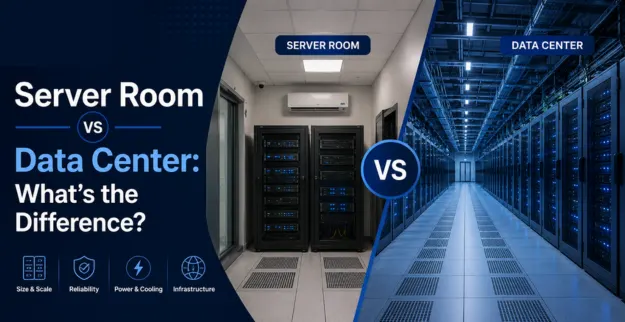
As businesses grow their IT needs, the whole infrastructure stuff gets more convoluted, like, pretty quickly. Knowing the actual difference between a server room and a data center helps organizations pick up the right setup for performance, security, and future growth, or “scalability” if you want to be extra formal.
What is a Server Room?
A server room is kind of a dedicated space inside an office building where you keep servers, the networking equipment, and storage devices needed for everyday business operations. Usually, it is arranged for small to medium sized organizations, not really for huge campuses, though it can vary.
What is a Data Center?
A datacenter is some kind of specialized facility put together to house big scale IT infrastructure, like servers' storage systems and networking gear, plus power backup, and then advanced cooling systems too. It’s there so you can keep things up and running, with high availability in mind and proper business continuity.
Key Differences and Benefits
| Feature | Server Room | Data Center |
|---|---|---|
| Size | Small dedicated room | Large, specialized facility |
| Capacity | Limited server capacity | Supports thousands of servers |
| Scalability | Limited expansion options | Highly scalable infrastructure |
| Power Backup | Basic UPS systems | Redundant power and generators |
| Cooling | Standard air conditioning | Advanced cooling systems |
| Security | Basic physical security | Multi-layer security controls |
| Monitoring | Basic monitoring tools | Advanced Data Center Monitoring |
| Reliability | Suitable for small businesses | High availability and uptime |
| Cost | Lower initial investment | Higher investment but greater efficiency |
| Best For | Small and medium businesses | Large enterprises and critical operations |
Selecting the Appropriate Infrastructure
- ♦ Select a Server Room Solution if your organization has minimal IT needs and a small user base.
- ♦ Choose a Data Center Solution in UAE if your business needs high availability and uninterrupted operations.
- ♦ Take into account future growth and scalability needs.
- ♦ Assess requirements related to security, compliance, and disaster recovery.
- ♦ Determine the needs for power, cooling, and monitoring.
- ♦ Seek advice from experienced IT infrastructure specialists prior to deployment.
Common Problems and Solutions
1. Challenges in the Server Room
- Issue: Overheating caused by insufficient cooling.
- Solution: Set up specialized cooling systems along with temperature monitoring.
- Issue: Insufficient room for growth.
- Solution: Design rack and cabinet setups that can be scaled effectively.
- Issue: Power outages.
- Solution: Install UPS systems and backup generators.
- Issue: Insufficient monitoring.
- Solution: Set up monitoring and alert systems for the server room.
Challenges in Data Centers
- Issue: Elevated operational expenses.
- Solution: Install energy-efficient equipment and improve how resources are used.
- Issue: Managing intricate infrastructure systems.
- Solution: Deploy centralized Data Center Monitoring solutions.
- Issue: Security risks.
- Solution: Implement robust physical and cybersecurity measures.
- Issue: Potential for system downtime.
- Solution: Implement redundant power, cooling, and network systems.
Conclusion
Both server rooms and data centers play important roles in keeping business operations moving. The right choice really depends on your organization's size, how you plan to grow, what availability requirements you have, and also the budget.