What Are Virtualization Solutions and Why Are They Important?
Introduction
Modern businesses pretty much need IT infrastructure that’s faster, more flexible, and also cost effective, like really. In many cases virtualization solutions help orgs to squeeze more value out of server performance, lower expenses, and keep business continuity from getting derailed too easily.
What is Virtualization?
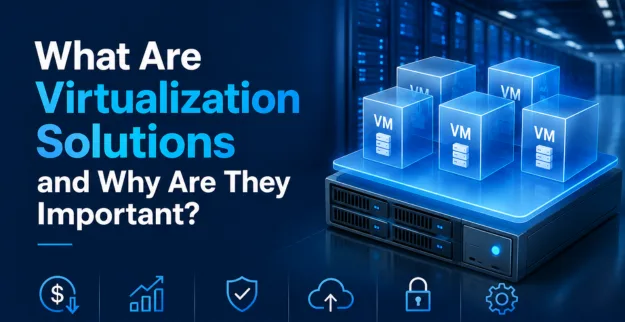
Virtualization is kind of the process where you create virtual machines, that run multiple operating systems and different applications on one physical server, all together. It lets businesses make better use of their IT resources, in a way that feels more efficient, mostly because of those advanced virtualization platforms and their usual capabilities.
Types of Virtualization
1. Server Virtualization
Basically, it lets a bunch of virtual servers run on a single physical machine, so you are not wasting capacity. It tends to boost hardware utilization, also it can cut down infrastructure expenses, kind of in a practical way.
2. Desktop Virtualization
It’s where users can access their desktops from basically any device, even if the hardware is different. Then you get centralized management, and the data feels more protected, because it stays in a controlled environment.
3. Storage Virtualization
It merges multiple storage devices into one pooled setup, which makes the whole storage management a lot simpler. Also, it often improves backup and recovery, since operations can be handled more consistently.
4. Network Virtualization
Here it creates virtual networks instead of relying only on physical ones. That improves network flexibility, and it can simplify network administration too, though the setup might feel a bit involved at first.
5. Application Virtualization
These runs applications without installing them locally on every device. Deployment becomes easier, and it can reduce compatibility problems; you know those annoying mismatches between versions and systems.
Business Benefits of Virtualization Solutions
1. Lower IT Costs
- ♦ It cuts down on the count of physical servers, so there is less stuff running.
- ♦ Also saves electricity and for sure the cooling expenses.
- ♦ It minimizes the costs tied to hardware upkeep and maintenance.
2. Better Use of Resources
- ♦ Makes server performance way more solid, in a sense.
- ♦ Helps share computing power in a more efficient manner, so nothing just sits around.
- ♦ Removes the “idle hardware” problem, really uses the underutilized devices.
3. Better continuity of business
- ♦ Faster data backup and recovery after disasters, so things don’t go sideways as long.
- ♦ Quick restoration for the virtual machines, you know, get them up again sooner.
- ♦ This also cuts down on business downtime, helps keep the operations running even when something happens.
4. Easy Scalability
- ♦ Deploy new virtual machines, fast.
- ♦ Expand your infrastructure as the business grows steadily.
- ♦ Also adapts to changing requirements for the company.
5. Improved Security
- ♦ Separates workloads across virtual machines.
- ♦ Makes security updates easier and more straightforward.
- ♦ Strengthens data protection overall.
6. Simplified IT Management, more or less
- ♦ They handle server administration in a central spot.
- ♦ Software deployment happens faster, and without the usual hassle.
- ♦ Monitoring and maintenance become easier to keep up with, overall, it feels simpler.
Use Cases and Real-Time Examples
- ♦ Construction Companies: host project management plus CAD tools on centralized virtual servers, so everything feels connected and smoother.
- ♦ Contracting Companies: run ERP and accounting systems through server virtualization, almost like one controlled environment.
- ♦ Interior Design Companies: Support high-performance design software with virtual machines, for faster renderings and calmer workflows.
- ♦ Facility Management Companies: manage CCTV, access control, and building management systems efficiently using virtualization.
- ♦ Consulting Companies: host client applications and databases in a secure way on dependable virtualization platforms, not just anywhere.
- ♦ Remote Teams: access business applications safely from basically any location, with less friction overall.
Constraints from Virtualization
- ♦ The first setup may need some expert planning, like before you touch anything.
- ♦ For high-performance workloads, you need enough hardware resources, or everything starts acting weird.
- ♦ Software licensing can end up raising the deployment costs a bit, even if you planned for less.
- ♦ If resource allocation is done poorly, you may see slowdowns and uneven behavior.
- ♦ Regular monitoring and upkeep are basically essential, not optional anymore.
Conclusion
Virtualization solutions help businesses in ways like improving efficiency, cutting costs, and making IT management feel less messy. When companies use server virtualization, plus virtual machines that run like usual, and virtualization platforms that are reliable, they can end up with an IT environment that’s secure but also scalable, so it’s ready for future growth.