Why Financial Companies Cannot Afford Server Downtime
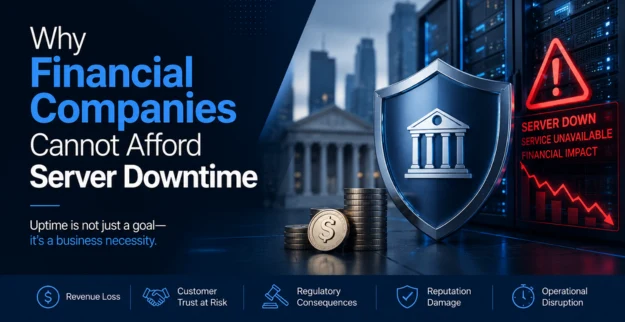
In the financial industry, every second server downtime can cause lost transactions, customer frustration, and compliance worries, not ideal. Reliable IT infrastructure is needed to keep banking operations running without interruption, protect data access, and keep financial services flowing as expected.
Financial Companies Cannot Afford Server Downtime
1. Real Time Transaction Handling
- ♦ Financial institutions handle thousands of transactions every minute, basically.
- ♦ If server downtime happens, it can interrupt payment processing and stall fund transfers.
- ♦ Those delays, even if short, can still shake customer confidence and mess with regular business operations.
2. Customer Service Availability
- ♦ Most customers want constant access, meaning 24/7 to banking and financial services.
- ♦ Any downtime can stop users from reaching their accounts and even the applications.
- ♦ When service interruptions show up, they may trigger customer complaints, plus that can harm reputation over time.
3. Regulatory Compliance Requirements
- ♦ Financial organizations must follow very strict compliance standards, and so on.
- ♦ Sometimes system outages cause reporting delays and make audit stuff harder.
- ♦ Keeping the uptime stable helps with meeting both regulatory duties and security commitments, basically.
4. Data Security and Protection
- ♦ Financial systems hold seriously sensitive customer information.
- ♦ Any downtime can up, vulnerabilities during recovery processes, like it’s easier for risks to sneak back in.
- ♦ Secure backup and recovery solutions, do help shield critical data, even when everything gets messy or delayed.
5. Business Continuity and Recovery
- ♦ For financial companies, it is about keeping things running without interruption.
- ♦ A solid disaster recovery plan helps reduce service disruptions, even when something goes wrong, like power issues or outages.
- ♦ With fast recovery you basically lower both financial risk and operational risk, and that matters a lot in practice.
Financial Dependency
- ♦ Banking IT systems depend on continuous server availability, like almost always.
- ♦ Online banking platforms need real-time data access for things that do not get stuck.
- ♦ Financial transactions hinge on a steady network infrastructure, without surprises.
- ♦ Customer records should stay reachable at all times, no delays.
- ♦ Compliance reporting systems demand uninterrupted operation, otherwise it becomes messy fast.
Cost Impact
- ♦ Revenue loss from interrupted dealings or payments.
- ♦ Lower worker output during those outages, like people just can't get to what they need.
- ♦ Higher expenses tied to IT recovery work and troubleshooting, basically spending more time and more effort than planned.
- ♦ Client dissatisfaction, and maybe even account closures later.
- ♦ Also, there can be possible regulatory fines for non-compliance, depending on how the situation plays out.
Risks & Recovery
| Risks | Recovery Solutions |
|---|---|
| Transaction failures | Automated backup systems |
| Data loss | Regular data replication |
| Customer service disruption | Disaster recovery planning |
| Compliance violations | Continuous monitoring and reporting |
| Security vulnerabilities | Advanced cybersecurity protection |
| Operational delays | High-availability server infrastructure |
| Reputation damage | Rapid incident response procedures |
Conclusion:
Server downtime can seriously affect finance operations, customer trust, and even compliance requirements, honestly. Putting money into dependable recovery and business continuity solutions helps financial firms keep secure services running without interruption. It also keeps everything steadier, in a way that matters.